
For businesses in Muscat, statutory audit and tax services Muscat work best when they are coordinated around reliable financial records that comply with Oman's regulatory framework. A tax filing with the tax authority can be delayed by an issue that began months earlier in the bookkeeping. The practical challenge is to connect audit, accounting, and tax work without confusing their separate responsibilities.
It is understandable to want clarity on which audit, accounting, corporate tax, and VAT requirements apply under local laws, and which records need attention first. This guide explains how these services differ, how bookkeeping and tax preparation inform financial reporting, and why tax support does not replace an independent audit opinion. It also outlines practical ways to define a scope that fits your company’s circumstances in Oman.
AOWJ Business Consultants supports businesses with statutory and external audits, bookkeeping, IFRS conversions, corporate tax, and VAT compliance. The sections ahead explain how these capabilities can be coordinated while preserving the distinct purpose of each mandate, helping your business organize its records and compliance work with greater clarity.
Key Takeaways
- Understand how statutory audit, bookkeeping, corporate tax, VAT, and IFRS support serve different purposes in a company’s reporting cycle.
- Compare these workstreams to identify which services fit your company’s reporting and compliance needs in Oman.
- Map the flow from bookkeeping records to financial statements, independent audit, and tax work to identify coordination needs early.
- Use a four-stage workflow to scope responsibilities, organize records, align reporting, and review deliverables.
- See how AOWJ Business Consultants can tailor audit, bookkeeping, IFRS, corporate tax, and VAT support to your business requirements.
Why Muscat businesses consider statutory audit and tax services together
For a company operating in Oman, the practical decision is how to establish reliable financial reporting while meeting the obligations that apply to its entity. Considering audit and tax support together can help management understand how records, financial statements, and filings relate, without treating these activities as one interchangeable service. The appropriate scope depends on the company’s structure, operations, and applicable requirements.
A statutory audit is an independent examination of financial statements that results in an auditor’s opinion. It assesses whether the statements are fairly presented under the applicable reporting framework. It is not a review of every tax position or preparation of the company’s returns. The principles of a statutory financial audit help explain why independence and a clearly defined audit scope matter.
What statutory audit and tax services each address
Audit work focuses on the financial statements and supporting evidence, with the independent auditor reaching an opinion. Bookkeeping maintains the underlying transactions and records. Corporate tax support may cover registration, assessment preparation, and annual return filing, while VAT compliance is a distinct workstream involving VAT registration and return filing. The outputs connect, but each service has a separate purpose and responsibility.
Financial statement assurance is an independent auditor’s opinion; tax-return preparation applies tax rules to financial and transaction records to support a filing. This distinction matters when defining responsibilities: management supplies complete information, accounting work organizes the records, tax support addresses relevant tax treatment, and the auditor independently examines the financial statements. One deliverable should not be treated as a substitute for another.
Why the business context matters
Companies operating in Oman need to consider the commercial and tax environment relevant to their entity and activities. Obligations can vary with entity type, operations, reporting basis, and applicable rules. Requirements and procedures can change, so verify relevant filing and legal details for the period before relying on them.
Early scoping is more useful than assuming every company needs the same package. A company might need bookkeeping support to organize its ledger, corporate tax assistance for its return, VAT compliance for its taxable activities, an independent statutory audit, or a coordinated combination. An initial assessment should identify the entity’s reporting period, existing records, previous filings, and known obligations, then assign each task to the appropriate responsible party.
When assessing audit and tax support, look for a clear division of duties alongside practical coordination. AOWJ Business Consultants provides statutory and external audits, bookkeeping, corporate tax, and VAT compliance support. A coordinated view can connect these workstreams while preserving the auditor’s independent role and defining a scope around the company’s reporting and compliance needs.
How statutory audit, bookkeeping, and tax work connect in Oman
These workstreams form a sequence, but they do not become a single mandate simply because they use some of the same financial records. Bookkeeping captures and organizes transactions; accounting processes use those records to prepare financial statements; an independent auditor examines the statements and supporting evidence; and tax work uses relevant financial information to prepare separate filings. Clear handoffs help management understand what is being prepared, reviewed, or reported at each stage.
Consider a company closing its books for a reporting period. If supplier invoices, customer balances, payroll entries, or bank reconciliations are incomplete, the ledger may not provide a sound basis for financial statements. That can make it harder to assemble audit evidence and prepare tax calculations or returns from consistent figures. Resolving differences early gives management a clearer view of the accounts and supports better-informed reporting and compliance decisions.
Coordination improves visibility across records, reporting, and filings while preserving the separate responsibilities of management, tax advisers, and the independent auditor. Management remains responsible for the financial information and the judgments used to prepare it. An auditor assesses evidence and issues an opinion; that opinion does not replace management’s responsibility, and tax-return preparation is not part of the auditor’s independent conclusion.
Where bookkeeping and IFRS support fit
Bookkeeping maintains organized transaction and account records, including the entries and reconciliations that feed the reporting process. IFRS conversion support addresses the work required to align financial reporting with applicable standards, based on the company’s existing accounting records and reporting needs. Keeping these responsibilities clear helps identify whether a difference originates in source records, accounting treatment, or presentation, rather than treating every discrepancy as an audit issue.
For practical control, management can maintain a record of unresolved account balances, supporting documents, and significant reporting judgments. This gives accounting teams information to prepare the statements and gives the auditor a traceable basis for examination. Technical accounting decisions should be considered in light of the company’s circumstances and applicable reporting framework.
Where corporate tax and VAT support fit
Corporate tax support may include registration, assessment preparation, and annual return filing. VAT support is a separate process focused on registration and return filing. Neither replaces bookkeeping or the independent audit, although both rely on relevant transaction and accounting information. Reconciled records can help the team preparing a corporate tax return work from consistent financial figures, while VAT processes draw on transaction records relevant to VAT reporting.
A finance team can make handoffs clearer by maintaining a shared reporting calendar, naming an owner for each task, and documenting how key balances reconcile between ledgers and reporting schedules. These controls do not guarantee an outcome, but they can expose missing information before it affects multiple workstreams. Businesses reviewing statutory audit and tax services Muscat can use this workflow to define responsibilities while keeping each mandate distinct. AOWJ’s audit and tax advisory support can be scoped around those reporting and compliance needs.
How to assess statutory audit and tax service scope in Muscat
A useful scope starts with the company’s reporting and compliance needs, not with a bundled list of services. Audit, bookkeeping, corporate tax, VAT, and IFRS work may draw on overlapping records, but each has a distinct purpose and deliverable. A single consultancy engagement does not make these services interchangeable or remove the need to preserve the independence of a statutory audit.
Use the comparison below to identify relevant workstreams, then assess them against the entity’s circumstances and current Oman requirements. The outputs are typical examples, not a determination of what every company must obtain.
Statutory or external audit
Purpose: Independent examination of financial statements.
Typical output: An audit report and opinion.
Information relied on: Financial statements, ledgers, supporting records, and explanations provided by management.
Bookkeeping
Purpose: Maintain organized transaction and account records.
Typical output: Updated books, reconciliations, and accounting records.
Information relied on: Invoices, receipts, bank activity, payroll records, and other transaction documents.
Corporate tax
Purpose: Support tax registration, assessment preparation, and return filing.
Typical output: Registration or filing support and tax computations.
Information relied on: Accounting records, financial information, and relevant details of the company’s activities.
VAT
Purpose: Address VAT registration and return filing as a separate compliance workstream.
Typical output: Registration and return-filing support.
Information relied on: Transaction records and information relevant to VAT reporting.
IFRS support
Purpose: Assist with aligning financial reporting to applicable standards, including conversion work where needed.
Typical output: IFRS conversion or reporting support.
Information relied on: Existing accounting records, prior reporting bases, and financial information.
Which workstreams match common business needs?
A need for independent assurance points to statutory or external audit support. Incomplete books may call for bookkeeping, while accounting treatments or a change in reporting basis may require technical accounting or IFRS conversion support. Registration, assessment, or annual filing needs point to corporate tax assistance; VAT registration and returns belong to the separate VAT workstream. A company may need several services, but the scope should name each deliverable and its responsible party.
What to clarify before defining the engagement
Before setting the scope, document the reporting period, entity structure, condition of existing records, and division of finance responsibilities between management and external support. Distinguish recurring compliance requirements from a discrete assignment, such as an investigation or IFRS conversion. These details help define practical boundaries and handoffs.
For businesses comparing statutory audit and tax services Muscat, do not assume a company is exempt from audit or eligible for a particular filing treatment based on a general description. Applicable obligations depend on the entity and current rules in Oman. Verify those requirements for the relevant period before finalizing the engagement.
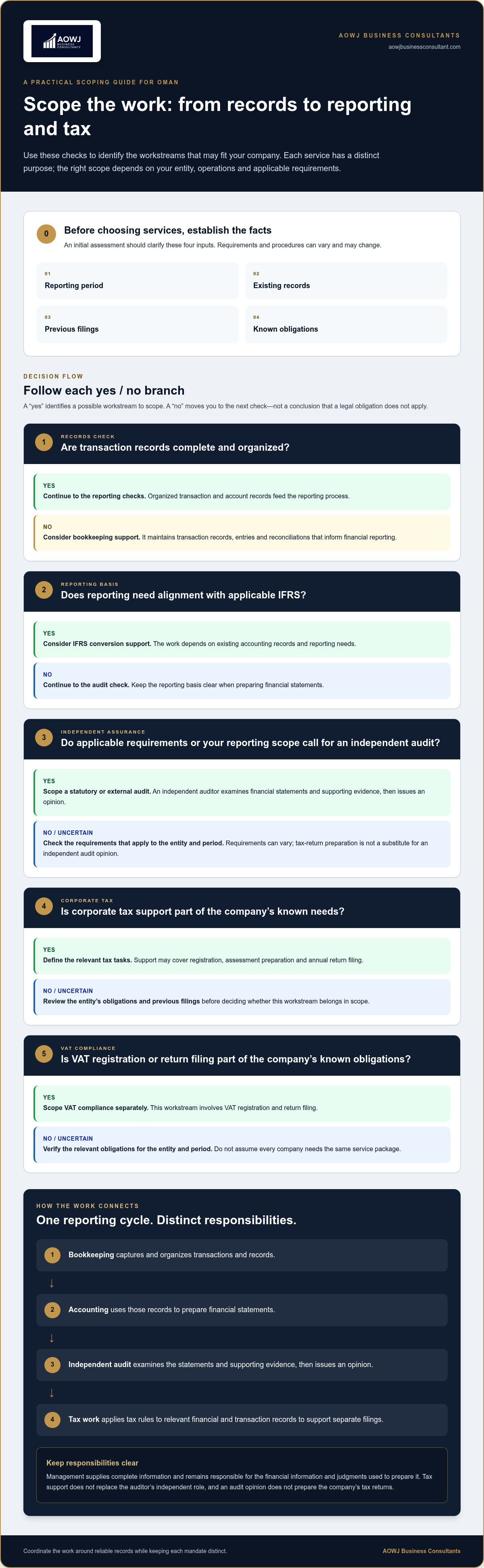
How Muscat finance teams can coordinate audit and tax work
Coordination works best when the finance lead establishes a sequence, assigns responsibility for each input, and keeps related workstreams visible without combining their mandates. The following four stages provide a high-level workflow for companies in Muscat. They are not a substitute for an audit-preparation checklist or an entity-specific review of Oman’s current requirements.
- Scope the work. Record the entity, reporting period, existing advisers, and requested workstreams, such as bookkeeping, statutory audit, corporate tax, or VAT. Identify who prepares the accounts, who provides tax inputs, and who performs the independent audit. Note dependencies, including when accounting close must be completed before audit fieldwork and when financial information is needed for tax preparation.
- Organize records. Assign internal owners for maintaining transaction records, reconciling accounts, responding to document requests, and explaining unusual balances. Management remains responsible for maintaining the company’s records and reviewing and approving its financial information. Set a process for storing source documents and recording unresolved matters so queries do not get lost between finance, tax, and audit teams.
- Align reporting. Use consistent account balances and supporting schedules across relevant workstreams, while preserving the distinct purpose of each output. For example, if a balance changes after a reconciliation, update the appropriate reporting schedules and communicate the change to those preparing related tax information. Document the reason and supporting basis rather than allowing different teams to rely on unexplained versions of the same figure.
- Review deliverables. Track audit questions, tax filing inputs, and unresolved accounting matters in a shared register, with an assigned owner, status, and next action for each item. Before a submission or final report is approved, management should review its information for consistency, completeness, and appropriate authorization. Record which deliverables are complete and which still depend on management input.
A simple responsibility matrix can make this sequence operational. Finance might own account reconciliations, a designated manager might approve financial information, and the relevant adviser might coordinate tax inputs or respond to technical questions. The independent auditor’s evidence requests and conclusions remain separate. An integrated timetable should improve visibility, not compromise the auditor’s independence or transfer management’s responsibilities.
Keep statutory details current. Applicable deadlines, required documents, filing procedures, and audit steps must be verified for each entity and reporting period under the rules in force in Oman. Avoid relying on a prior-year calendar or another company’s process as a definitive guide. Detailed document-by-document preparation belongs in a dedicated audit checklist; this workflow clarifies ownership and dependencies at a higher level.
For businesses arranging statutory audit and tax services Muscat, AOWJ Business Consultants can help define a coordinated scope across relevant reporting and compliance workstreams. Discuss your audit and tax coordination needs with AOWJ.
AOWJ statutory audit and tax support in Muscat: defining next steps
For businesses operating in Oman, the next step is to translate reporting and compliance requirements into a clear scope of work. AOWJ Business Consultants is based in Muscat and supports companies with statutory and external audits, bookkeeping, IFRS conversions, corporate tax registration and return support, and VAT registration and return filing. These services can be coordinated around a company’s reporting cycle while keeping each service’s purpose and responsibilities distinct.
What AOWJ can coordinate for Oman businesses
Statutory and external audit work concerns the independent examination of financial statements and the resulting audit opinion. Bookkeeping supports the organization and maintenance of accounting records, while corporate tax assistance addresses registration, assessment preparation, and return support. VAT registration and filing are a separate compliance workstream. Coordinating timelines and information between these areas can give management a clearer view of dependencies, but tax or bookkeeping support does not replace an independent audit opinion.
The appropriate scope depends on the company’s circumstances. A business with established records may need a defined audit and tax scope, while a company with incomplete reconciliations may first need bookkeeping support. IFRS conversion work may be relevant where financial reporting needs alignment with applicable standards. Forensic investigations are a distinct assignment for a specific need to examine financial information or transactions.
Prepare for an initial scope discussion
Decision-makers can make an initial discussion more focused by assembling a concise overview of the entity structure, reporting period, current accounting records, and requested support. Identify who within the company maintains the books, approves financial information, responds to audit questions, and provides inputs for tax and VAT filings. A brief outline of existing reporting processes and unresolved accounting matters can also help clarify priorities and dependencies.
This preparation is not a substitute for confirming the rules that apply to the entity. Audit obligations, filing procedures, deadlines, and required documentation should be assessed against current Oman requirements and the company’s specific facts. The engagement scope can then distinguish recurring work, such as bookkeeping or tax-return support, from defined assignments such as an IFRS conversion or forensic investigation, with deliverables and responsibilities set out accordingly.
Businesses evaluating statutory audit and tax services Muscat can use this approach to move from a broad request for support to a practical engagement scope. AOWJ can discuss the company’s audit, accounting, corporate tax, and VAT requirements and shape the work around its reporting and compliance needs. Contact AOWJ Business Consultants to discuss the appropriate next steps for your business.
Turn your reporting priorities into a clear scope
The next step is to convert your company’s reporting priorities into a short, decision-ready brief. Identify the period under review, the areas where records or responsibilities need attention, and any decisions that depend on audit or tax work. This gives the scope discussion a practical starting point and helps distinguish immediate requirements from improvements that can be planned over time.
For businesses considering statutory audit and tax services Muscat, clarity at this stage can support a more coherent engagement, with defined deliverables, accountable owners, and appropriate separation between advisory work and independent assurance. The aim is not to combine every task, but to establish how each relevant workstream can support sound reporting and compliance for the company’s circumstances.
For companies managing business connections between Oman and Dubai, London, Riyadh, Dammam, Mumbai, Doha, Paris, or Shanghai, a clear scope can also help keep reporting responsibilities understandable across teams. Use your brief to begin a focused discussion with AOWJ about the support your business requires. Discuss your statutory audit and tax requirements with AOWJ, and take the next step with a clear view of your priorities.
Frequently Asked Questions
Is a statutory audit mandatory for every company in Oman?
Not necessarily. Whether an audit is mandatory depends on the company’s legal form, governing documents, circumstances, and rules applicable to its reporting period. A decision should not rely solely on another company’s practice or size. For a 2026 assessment, confirm the entity-specific obligation and any relevant appointment or reporting requirements under current Oman rules before planning the audit timetable, with appropriate professional guidance where needed.
Does a statutory audit include corporate tax return preparation?
No. A statutory audit results in an independent opinion on financial statements; it does not by itself prepare a corporate tax return. Corporate tax registration, assessment preparation, and return filing are separate tasks that use relevant company information. For example, a year-end balance may appear in both audit support and tax working papers, but the tax filing remains a distinct deliverable with its own preparation and review responsibilities.
Can a business use one adviser for audit and tax services in Muscat?
Yes, one consultancy can coordinate separate audit and tax scopes, helping align information requests and timelines. Coordination does not mean the same person should prepare accounting records and independently audit that work where doing so would impair independence. Management must still maintain and approve its financial information. Businesses considering statutory audit and tax services Muscat should ensure responsibilities and independent audit arrangements are clearly defined from the outset.
How often does an Oman business need a statutory audit?
There is no single frequency that can be assumed to apply to every Oman business. The applicable obligation depends on the entity and current rules, so assess it for the company’s specific reporting period rather than relying on a general timetable or another entity’s practice. Before setting recurring audit dates, verify whether an audit is required and confirm the relevant reporting period and procedural requirements under rules in force.
What happens if a company’s accounting records are incomplete before an audit?
Incomplete records can make it harder to support account balances, answer audit queries, and prepare reliable financial information. The finance team can identify missing reconciliations or source documents and organize remediation, potentially with bookkeeping or technical accounting support. For example, unexplained differences between a ledger balance and its supporting schedule may need investigation. This work can improve readiness, but it does not replace the independent audit or determine its outcome.
Are VAT services separate from corporate tax services in Oman?
Yes. VAT and corporate income tax are distinct compliance areas, with separate registration and filing processes where applicable. A company may use shared accounting records to support both, but the information and reporting tasks should be organized for each tax type. For example, finance teams can reconcile transaction records while maintaining separate VAT and corporate tax workpapers. Verify current Oman procedures and the company’s specific obligations rather than relying on generalized thresholds or deadlines.
Can IFRS conversion support be relevant before a statutory audit?
Yes, IFRS conversion support may be relevant before an audit if the company’s reporting basis needs to be aligned with applicable standards. Reviewing the reporting framework early can help identify accounting matters that affect financial statement preparation and the information presented for audit. Conversion work is distinct from audit assurance, however, and does not itself produce an independent audit opinion. Whether it is needed depends on the entity’s reporting circumstances and applicable requirements.